AOur next day of temple exploring began at Ta Prohm, one of the temples I was most looking forward to. The temple is also known as the Jungle Temple, or, as our guide insisted on constantly mentioning the "Tomb Raider Temple" due to its use in the Tomb Raider film. I got a bit irritated by him repeatedly saying tourists came to the temple because of its film, since I, at least, had known about for a long time and didn't even know it was associated with the movie. Perhaps the reason some people call it the Tomb Raider Temple isn't because that's where they know if it from, but because that's the name that at least some of the guides seem to insist on using?
Exasperation with the guide aside, the temple was crowded but lovely. Unlike the other temples, Ta Prohm was left largely in the state it was rediscovered, with trees growing over and through it where the jungle had begun to take over. The organic beauty of the nature mixed and part of the temple makes the entire place seem much more alive.
The final two temples visited were older and made of brick instead of stone. I'm not positive on which temples they were, but I think East Mebon and Pre Rup. These temples had a much more open, spacious feel to them, only heightened by the fact that they weren't so choked with other tourists.
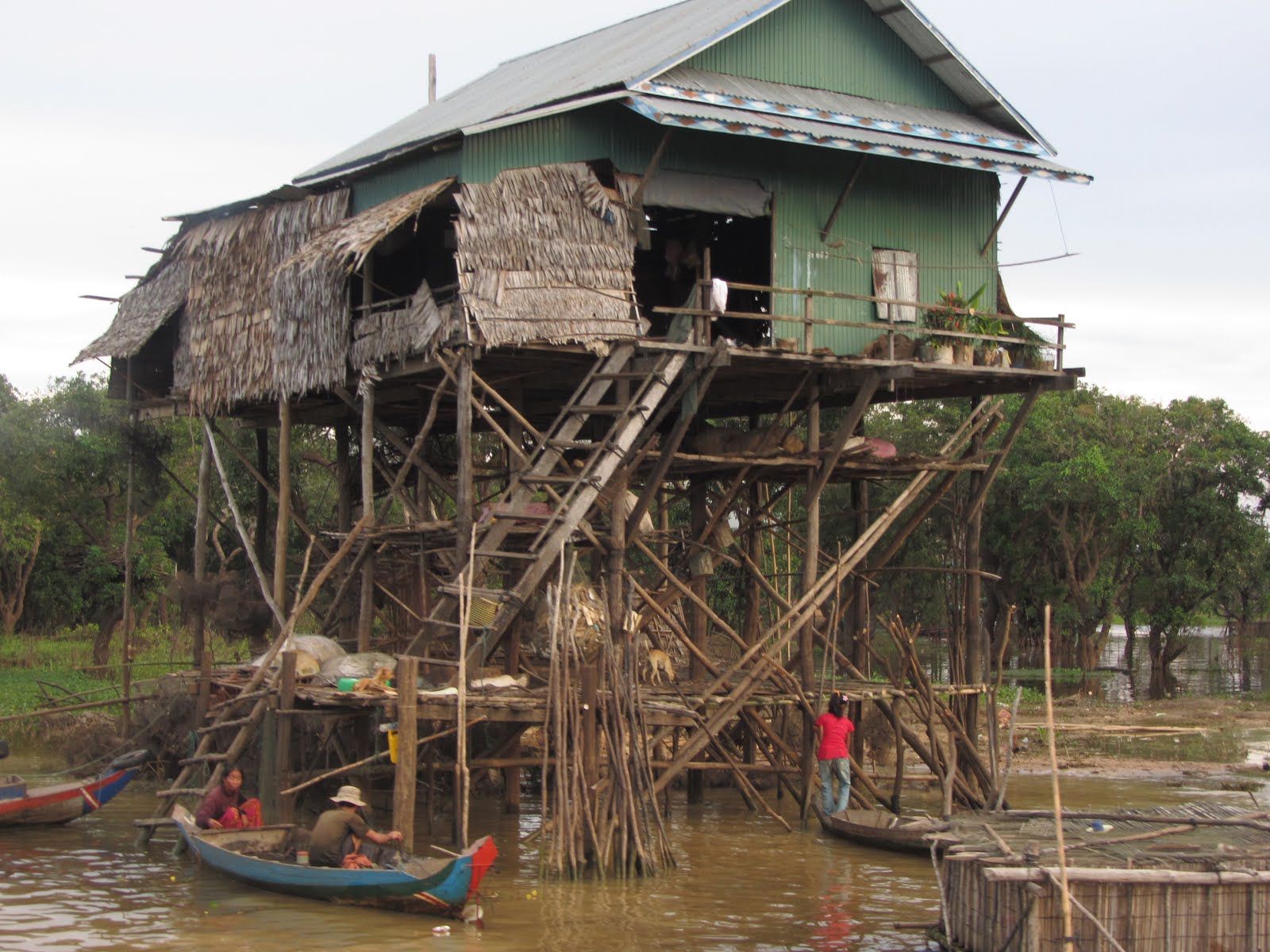
In the evening we drove out to the river near Tonle Sap, the largest lake in southeast Asia. We got on a boat and road through the adjacent mangrove forests while snacking on grilled snakes. Eventually we got to village of Kompong Phluk which is built over the river on stilts. The town has a very cool atmosphere, with everybody moving around in boats, floating cages of pigs, and elaborate latticework of bamboo and wood beneath all the buildings.
We finally made it to the lake and floated on it for awhile, waiting for sunset. Unfortunately it was too cloudy, and we couldn't see the sun at all, so it was a bit of a waste. This is also the point where the driver discovered the light on the boat wasn't working, so we rushed back down the river, trying to beat out the fading light. We got back without hitting anything, although it was almost completely dark by the time we did, and returned back to the hotel for our last night in Siem Reap.
I have always enjoyed a deep fascination of the world around me and a desire to seek out the small adventures and bits of wonder that are found everywhere if you look for them. Now I look to combine these in a voyage that will take over a year and cover over 30 countries on 5 continents. This blog is meant to be both informative and entertaining in its account of the trip.
Friday, December 7, 2012
Day 248: The Temples of Angkor (Part 1)
Siem Reap, despite not being especially big, is the most popular destinations in Cambodia for a single reason: the Angkor Temples. The area was the heart of the Khmer empire for almost 600 years, during its peak, and they loved building temples. During a long period of instability from wars with neighbors, occupation and civil war all the temples fell into extreme neglect and became ruins, but during their occasional periods of stability in the last hundred years the temples have slowly been pieced back together.
We got up early in the morning to watch the sun rise at the famous Angkor Wat. Before visiting the site we had to get our photos taken and stamped onto badges for a 3 day pass to all the temples in the area. The area was a bit busy as coming to watch the sunrise is a popular tourist draw, but we were only staying for the sunrise and then coming back later in the day to really explore the place. Randomly I came across one of my group members from my India/Nepal tour who was also in Cambodia on further travels, and we caught up a bit. It's a bit strange how you keep running into people unexpectedly you last saw thousands of kilometers away.
After returning back to the hotel for some breakfast and a short rest we headed back to Angkor Wat for a more thorough visit. While the thick stone stairways and towers of the iconic structure are impressive enough, the best part of the temple are the long bas-relief friezes showing scenes from Hindu mythology.
During our visit at Angkor Wat our local guide gave us a constant stream of lessons on both the temple in general, Khmer history, and different aspects of modern Cambodian life. He showed a special interest in Cambodian astrology, which he picked up some of during a brief stint as a monk acolyte in his childhood, and how it's roll in romantic matchmaking. Even more important than the astrological compatibility of the couple, however, is the size of the dowry the husband is able to pay the wife's family. Or, as our guide eloquently summed it up for us, "No money, no honey!"
We had lunch at one of the many nearby outdoor restaurants. I had a tasty Cambodian dish called amok, which is only especially of note this time because it was served in a green coconut. I also had a lychee Fanta, which is especially of note because it's lychee Fanta.
The next temple was Bayon in the Angkor Thom complex. Bayon is another very famous piece of architecture, primarily for its collection of 216 Buddha faces spread across the towers. I had been afraid that I'd get bored by the similarity of all the temples in the area, but each one seemed to have its own unique personality.
The third and final temple of the day was Baphuon. It had a step pyramid shape, and in my opinion the least personality of the three. On the backside of the temple there is a giant reclining Buddha statue that they are still working on putting back together.
After getting down from the temple on the opposite side and walking around a bit I came upon a tree that was just too tempting to pass up. The few moments distraction is caused led to me getting briefly separated from the group and lost, and upon reuniting got me a short lecture ("Does your insurance cover climbing up trees??"). Ultimately though, the risks of walking around in the Cambodia traffic are more likely to get me hurt than climbing a tree, and if I can't do the things that I find fun, what's the point?
We had a few more quick stops at the various ruins along the way back to the bus, at the Terrace of the Elephants and Terrace of the Leper King.
We had all been up since very early in the morning, and the day was hot and very humid, so were were all pretty exhausted by this point. We went on back to the hotel and mostly spent the evening relaxing.
We got up early in the morning to watch the sun rise at the famous Angkor Wat. Before visiting the site we had to get our photos taken and stamped onto badges for a 3 day pass to all the temples in the area. The area was a bit busy as coming to watch the sunrise is a popular tourist draw, but we were only staying for the sunrise and then coming back later in the day to really explore the place. Randomly I came across one of my group members from my India/Nepal tour who was also in Cambodia on further travels, and we caught up a bit. It's a bit strange how you keep running into people unexpectedly you last saw thousands of kilometers away.
After returning back to the hotel for some breakfast and a short rest we headed back to Angkor Wat for a more thorough visit. While the thick stone stairways and towers of the iconic structure are impressive enough, the best part of the temple are the long bas-relief friezes showing scenes from Hindu mythology.
During our visit at Angkor Wat our local guide gave us a constant stream of lessons on both the temple in general, Khmer history, and different aspects of modern Cambodian life. He showed a special interest in Cambodian astrology, which he picked up some of during a brief stint as a monk acolyte in his childhood, and how it's roll in romantic matchmaking. Even more important than the astrological compatibility of the couple, however, is the size of the dowry the husband is able to pay the wife's family. Or, as our guide eloquently summed it up for us, "No money, no honey!"
We had lunch at one of the many nearby outdoor restaurants. I had a tasty Cambodian dish called amok, which is only especially of note this time because it was served in a green coconut. I also had a lychee Fanta, which is especially of note because it's lychee Fanta.
The next temple was Bayon in the Angkor Thom complex. Bayon is another very famous piece of architecture, primarily for its collection of 216 Buddha faces spread across the towers. I had been afraid that I'd get bored by the similarity of all the temples in the area, but each one seemed to have its own unique personality.
The third and final temple of the day was Baphuon. It had a step pyramid shape, and in my opinion the least personality of the three. On the backside of the temple there is a giant reclining Buddha statue that they are still working on putting back together.
After getting down from the temple on the opposite side and walking around a bit I came upon a tree that was just too tempting to pass up. The few moments distraction is caused led to me getting briefly separated from the group and lost, and upon reuniting got me a short lecture ("Does your insurance cover climbing up trees??"). Ultimately though, the risks of walking around in the Cambodia traffic are more likely to get me hurt than climbing a tree, and if I can't do the things that I find fun, what's the point?
We had a few more quick stops at the various ruins along the way back to the bus, at the Terrace of the Elephants and Terrace of the Leper King.
We had all been up since very early in the morning, and the day was hot and very humid, so were were all pretty exhausted by this point. We went on back to the hotel and mostly spent the evening relaxing.
Location:
Angkor, Phnom Penh, Cambodia
Monday, December 3, 2012
Day 247: Country Living
We were to leave for Siem Reap early in the afternoon, but had the entire morning in Battambang to get a feel for things. Instead of staying in town we did a tour around the surrounding countryside villages on a mix of motorbikes and tuk-tuks. The little towns in Cambodia seem to be very focused on a single product. Farming is a constant everywhere, but each little individual stretch of buildings has some special craft or food product that they specialize in.
The first place we went was the local country market. I've been to quite a few markets by now, and I didn't find the Cambodia ones all that different, beyond some different fruits and vegetables.
It briefly started to rain fairly hard, so we pulled over to a shelter at the side of the road where people were making a common rice snack. I didn't get the exact specifics of the recipe, but the principle is to take some uncooked rice, pour it down a piece of bamboo, mix in whatever else (sugar possibly? raisins?) and add some water, then stick it in the coals of a fire to cook and expand up the length of the bamboo. Then you just peel the bamboo stem leaving this bar of rice to snack on.
The rain moved on, and so did we. The next stop was a little bizarre. We stepped into the dark underground world of Cambodia's illegal bloodsport... Fish fighting! Why something that is apparently illegal is included on a tour I'm not terribly sure, but as animal fighting goes fish fighting is pretty unimpressive. Apparently the rural folk take it pretty seriously, and on fight nights there can be 20 or 30 jars/arenas of battling pairs at once. This isn't exactly fast and furious with fish tearing each other apart - fights tend to go on for 2 or 3 hours apprently, and from the 5 minutes or so we saw, progress is pretty slow. Not terribly surprising the place also had a still making the local Cambodian liquor which we got some samples of. It's strong stuff, but not as strong as the Chinese rice wine.
Further along we got to another little village by the river that specialized in fish. All along the street rows of fish were drying in the sun, and around the block people were going through various steps of making and storing fish paste (a truly vile looking /smelling product).
Having a fishing village on a river that makes dried fish and fish paste seems like common sense to group together, but the next village down the road was a bit stranger. House after house along the road was dedicated to just one product - spring roll paper. Not spring rolls - just the paper you use to wrap spring rolls in. Unless maybe some distributor comes to the area and buys up all the paper at once I don't really understand why everybody in this specific area chooses to make spring roll paper, but like I said, that's just how things are done in Cambodia.
Finally we got to focal point of the day - the bamboo train. In the early 1900s, when Cambodia was under French rule, the French built a train line through the area. The tracks are still there, but the only problem was that there were no more trains. With a little hillbilly innovation the local villagers came up with the perfect solution: take a bamboo raft, put it on the rails, and stick a motor on the back. Instant train! The ride isn't the most comfortable, but hey, it gets you where you're going. When it's time to turn around, changing directions is as easy as lifting up the train, turning it around 180 degrees, and setting it back down again.
We split up for lunch then met back at the hotel to check out and get back on the bus to go to Siem Reap. It was a pretty long ride, made slightly longer by a blown tire we had along the way. The delay wasn't as bad as it could have been, as the tire blew out conveniently/suspiciously right next to a mechanics place. After the fix we were back on the road, and got into Siem Reap in the evening.
The first place we went was the local country market. I've been to quite a few markets by now, and I didn't find the Cambodia ones all that different, beyond some different fruits and vegetables.
It briefly started to rain fairly hard, so we pulled over to a shelter at the side of the road where people were making a common rice snack. I didn't get the exact specifics of the recipe, but the principle is to take some uncooked rice, pour it down a piece of bamboo, mix in whatever else (sugar possibly? raisins?) and add some water, then stick it in the coals of a fire to cook and expand up the length of the bamboo. Then you just peel the bamboo stem leaving this bar of rice to snack on.
The rain moved on, and so did we. The next stop was a little bizarre. We stepped into the dark underground world of Cambodia's illegal bloodsport... Fish fighting! Why something that is apparently illegal is included on a tour I'm not terribly sure, but as animal fighting goes fish fighting is pretty unimpressive. Apparently the rural folk take it pretty seriously, and on fight nights there can be 20 or 30 jars/arenas of battling pairs at once. This isn't exactly fast and furious with fish tearing each other apart - fights tend to go on for 2 or 3 hours apprently, and from the 5 minutes or so we saw, progress is pretty slow. Not terribly surprising the place also had a still making the local Cambodian liquor which we got some samples of. It's strong stuff, but not as strong as the Chinese rice wine.
Further along we got to another little village by the river that specialized in fish. All along the street rows of fish were drying in the sun, and around the block people were going through various steps of making and storing fish paste (a truly vile looking /smelling product).
Having a fishing village on a river that makes dried fish and fish paste seems like common sense to group together, but the next village down the road was a bit stranger. House after house along the road was dedicated to just one product - spring roll paper. Not spring rolls - just the paper you use to wrap spring rolls in. Unless maybe some distributor comes to the area and buys up all the paper at once I don't really understand why everybody in this specific area chooses to make spring roll paper, but like I said, that's just how things are done in Cambodia.
Finally we got to focal point of the day - the bamboo train. In the early 1900s, when Cambodia was under French rule, the French built a train line through the area. The tracks are still there, but the only problem was that there were no more trains. With a little hillbilly innovation the local villagers came up with the perfect solution: take a bamboo raft, put it on the rails, and stick a motor on the back. Instant train! The ride isn't the most comfortable, but hey, it gets you where you're going. When it's time to turn around, changing directions is as easy as lifting up the train, turning it around 180 degrees, and setting it back down again.
We split up for lunch then met back at the hotel to check out and get back on the bus to go to Siem Reap. It was a pretty long ride, made slightly longer by a blown tire we had along the way. The delay wasn't as bad as it could have been, as the tire blew out conveniently/suspiciously right next to a mechanics place. After the fix we were back on the road, and got into Siem Reap in the evening.
Location:
Battambang, Cambodia
Day 246: The Kingdom of Cambodia
We had about a 4 hour ride by bus to the Thailand-Cambodia border, which we crossed on foot. The lines to leave Thailand were long and frustrating. They seemed to barely move as other people kept cutting in the line and pushing their way past. Eventually one dedicated officer with a megaphone took charge and locked the door most people were sneaking in through, reorganized the lines, and finally got things going more efficiently so we could get through. Getting our visas and passing into Cambodia was a much smoother and faster process, and soon it was time to get on a new bus to continue on in Cambodia.
Cambodia is an interesting country. Tourism is an important source of revenue for the country, but the vast majority of tourists only visit Siem Reap and/or Phnom Penh. I chose this tour specifically because of how thorough it was at exploring more of the rural areas of Cambodia as well - seeing the farms and small towns and getting a feel for how Cambodians really live. Compared to a lot of other countries Cambodia was also a pretty big mystery to me. I knew a little about Angkor Wat and had a vague understanding of the Khmer Rouge massacres, but things were pretty fuzzy beyond that, and the one way to really get to know a country is to experience as much of it as you can.
Once across the border it was a couple more hours to the city of Battambang, which is the second largest in Cambodia by population, but still rather small by international standards. After a long day of travel none of us were too keen on doing much in the evening beyond going out for a group dinner. Along the way I managed to get some US dollars out of an ATM, since it's really the currency of choice in the country. The exchange rate is 4000 Cambodian Riel = 1 US dollar. Everywhere takes payment in US dollars, or a mix of the currencies, but often you just get back riel. In general, and a bit to my surprise, things are quite a bit more expensive in Cambodia than in India/Nepal. I'm guessing it's mainly that the support infrastructure for tourists here is pretty isolated from what most of the locals use. There is definitely a considerable difference in prices between the big, tourist based cities and the rural towns.
Cambodia is an interesting country. Tourism is an important source of revenue for the country, but the vast majority of tourists only visit Siem Reap and/or Phnom Penh. I chose this tour specifically because of how thorough it was at exploring more of the rural areas of Cambodia as well - seeing the farms and small towns and getting a feel for how Cambodians really live. Compared to a lot of other countries Cambodia was also a pretty big mystery to me. I knew a little about Angkor Wat and had a vague understanding of the Khmer Rouge massacres, but things were pretty fuzzy beyond that, and the one way to really get to know a country is to experience as much of it as you can.
Once across the border it was a couple more hours to the city of Battambang, which is the second largest in Cambodia by population, but still rather small by international standards. After a long day of travel none of us were too keen on doing much in the evening beyond going out for a group dinner. Along the way I managed to get some US dollars out of an ATM, since it's really the currency of choice in the country. The exchange rate is 4000 Cambodian Riel = 1 US dollar. Everywhere takes payment in US dollars, or a mix of the currencies, but often you just get back riel. In general, and a bit to my surprise, things are quite a bit more expensive in Cambodia than in India/Nepal. I'm guessing it's mainly that the support infrastructure for tourists here is pretty isolated from what most of the locals use. There is definitely a considerable difference in prices between the big, tourist based cities and the rural towns.
Location:
Battambang, Cambodia
Sunday, December 2, 2012
Day 245: The Final Tour (For Now)
I had a relaxed morning in the hostel then packed my bags to transfer over to the hotel where I'd be starting my 3rd and final Asian tour - a trip through Cambodia. I had to take sky train and then transfer to the metro which was a little rough working out with my bags. The metro has a security check that is supposed to go through bags, and I was afraid they were going to have me unpack everything to go through my things. Luckily they didn't seem to care too much, and just had me open the zippers so they could stick a flashlight in - which is pretty much pointless since my bag was full and you couldn't see anything anyway. The metro stop was right next to the hotel, and after checking in I just explored this new part of the city for a few hours until it was time to meet my new group at the hotel.
The Cambodia group is the youngest group I've been with, with only two people over 35 I think, and everybody pretty young at heart. In terms of nationalities there are 7 English, 4 Australian, 2 German, 2 Canadian. I decided to make an effort for once and actually memorize things instead of just trying to remember them, and had all the names of the group memorized by the time we finished a group dinner. We only had the single night in Thailand together as the plan was to cross over to Cambodia by bus the following day.
Labels:
Accomodations,
Thailand,
Tour,
Travel
Location:
Bangkok, Thailand
Day 244: The Floating Market
Since I had spent all my time in Thailand so far in Bangkok I decided to do a day trip to a place a couple hours away from the city - the Damnoen Saduak Floating Market. I had booked the day trip through my hostel the evening before, and the company running it picked me up with a shuttle bus early in the morning. After a few stops for other people the bus went to the main office where everybody got off and switched to various new buses, depending on which of the many tours out of the city we were doing. The ride to the market was pretty uneventful, and not with any terribly interesting scenery unfortunately.
The floating market is about what the name suggests. It's a section of canals with some shops set up along the sides of the canals, and other shops and vendors being on boats, some tied down and some floating freely. When potential customers float by they will hook the boats with a stick and draw them in next to their little shop to browse. The shops tended to be pretty touristy, but it was still a nice, bustling atmosphere and certainly a unique type of shopping.
After looking around the market I met back up with the others on the trip and we got on a faster boat to go further through the canals, leaving the market and going through more resedential and eventually rural areas. Outside of town we finally docked and found our bus waiting for the trip back to Bangkok. Unfortunately the ride out wasn't as smooth as coming in. It started to rain, and now that it was in the afternoon traffic was much heavier. The ride that took about 2 hours in the morning took about 4.5 returning, most of which was in traffic jams trying to get through the city. After the long, dull ride through the city I was happy to get a bowl of my favourite curry once again and relax in the hostel for the evening.
The floating market is about what the name suggests. It's a section of canals with some shops set up along the sides of the canals, and other shops and vendors being on boats, some tied down and some floating freely. When potential customers float by they will hook the boats with a stick and draw them in next to their little shop to browse. The shops tended to be pretty touristy, but it was still a nice, bustling atmosphere and certainly a unique type of shopping.
After looking around the market I met back up with the others on the trip and we got on a faster boat to go further through the canals, leaving the market and going through more resedential and eventually rural areas. Outside of town we finally docked and found our bus waiting for the trip back to Bangkok. Unfortunately the ride out wasn't as smooth as coming in. It started to rain, and now that it was in the afternoon traffic was much heavier. The ride that took about 2 hours in the morning took about 4.5 returning, most of which was in traffic jams trying to get through the city. After the long, dull ride through the city I was happy to get a bowl of my favourite curry once again and relax in the hostel for the evening.
Location:
Damnoen Saduak, Thailand
Day 243: Cruising Chao Phraya River
One of the cheaper ways to get around Bangkok is using the ferry service along the Chao Phraya river. There are a few different boat routes, identified by different coloured flags on the boats, and there are nearly 40 docks that the most thorough ferry stops at. The places I most wanted to see were mostly located along the river, so hopping on the boats was a nice way to see things and get away from the traffic and crowds.
I took the ferry north and got off near Wat Pho. Wat Pho is most famous for a giant golden reclining Buddha statue housed in one of the temples, the site also has a mix of other statues, temples and other buildings to explore.
While in the area I walked next door to check out the Grand Palace. The price to actually go in was more than I wanted to spend, so I just walked around on the grounds outside for a bit.
I walked down to the next dock and took the ferry across to the other bank of the river to visit Wat Arun. Wat Arun is just a structure, so there wasn't really all that much to do there. The structure had an awesomely steep staircase which was the best part, in my opinion. Other visitors would go up (and especially down) clutching at the railing with both hands and slowly crawling up, and I would just bound by them. On the way down I got stuck behind an especially tentative group, and it took me almost 5 minutes waiting at each step for them to finally get down.
Since the price was the same no matter how far you go, I took the boat all the way up to the last stop to just enjoy the day, then took it all the way back and got off near my hostel and walked back.
I took the ferry north and got off near Wat Pho. Wat Pho is most famous for a giant golden reclining Buddha statue housed in one of the temples, the site also has a mix of other statues, temples and other buildings to explore.
While in the area I walked next door to check out the Grand Palace. The price to actually go in was more than I wanted to spend, so I just walked around on the grounds outside for a bit.
I walked down to the next dock and took the ferry across to the other bank of the river to visit Wat Arun. Wat Arun is just a structure, so there wasn't really all that much to do there. The structure had an awesomely steep staircase which was the best part, in my opinion. Other visitors would go up (and especially down) clutching at the railing with both hands and slowly crawling up, and I would just bound by them. On the way down I got stuck behind an especially tentative group, and it took me almost 5 minutes waiting at each step for them to finally get down.
Since the price was the same no matter how far you go, I took the boat all the way up to the last stop to just enjoy the day, then took it all the way back and got off near my hostel and walked back.
Labels:
Architecture,
Religion,
Thailand,
Travel
Location:
Bangkok, Thailand
Subscribe to:
Posts (Atom)