Our group was in pretty rough shape in the morning. Quite a few people had been ill for much of the entire trip, either because of food, or travel, or malaria medication. On top of that, those of us who had spent the previous night out drinking were all still somewhat drunk, or very hung over in the morning. All combined, not really the ideal condition to spend a day out in the heat hearing about the years of torture and murder by the Khmer Rouge.
We all felt that it was an important part of Cambodia's history and that the subject deserved our respect attention, so we all trooped out to Tuol Seng Prison (aka Security Prison 21). I was in much better shape than many of the group, but all the stories and imagery of the abuse, torture and murder that went on was still pretty overwhelming. In many ways it was a more vivid reminder than going to Auschwitz was, since it's much more recent and the site was preserved almost exactly as it was abandoned when the Vietnamese invaded to halt the genocide. Two of our group had to return back to the hotel before we finished the tour of the prison, and the rest of us were in a pretty quiet mood.
I'm not really sure how much to see about the Cambodian Genocide. The Khmer Rouge Communist Party came into power in Cambodia in 1975. They forced everybody out of all urban areas, tortured and killed anybody they thought might be educated or part of any resistance, and forced the rest to work in labour camps. Over the 3 years, 8 months, 20 days that the Khmer Rouge were in power, over 2 million people died (half by execution, half by starvation and disease in the camps), and the country's population had been cut nearly in half. Losing half the population of a country in less than 4 years is just insane, and the impact is still being felt now, as 50% of Cambodia's population now is 20 years old or younger. It's easy to forget what they went through when you wander around the country, but it's sobering to realize that virtually every adult you see lost a parent or sibling during this period.
Next we went out of town to one of the many killing fields spread throughout Cambodia. These were the sites where people were brought in truckloads for execution. Now the area is something of a memorial and quite peaceful. Most of the mass graves have been excavated, but each rainy season more bones and pieces of clothing get revealed in the mud.
We had the afternoon free, but most of us didn't venture anywhere too far off. I walked around the surrounding area for awhile and spent some time at the big central market, but spent the majority of the evening in the hotel resting.
I have always enjoyed a deep fascination of the world around me and a desire to seek out the small adventures and bits of wonder that are found everywhere if you look for them. Now I look to combine these in a voyage that will take over a year and cover over 30 countries on 5 continents. This blog is meant to be both informative and entertaining in its account of the trip.
Showing posts with label Politics. Show all posts
Saturday, December 8, 2012
Sunday, October 21, 2012
Day 189: The Summer Palace
There are 4 UNESCO World Heritage Sites in or close to Beijing - the Imperial Palace (Forbidden City), the Temple of Heaven, the Great Wall, and finally the Summer Palace. The palace had a long history, dating back around 700 years, but it is most associated with the Empress Dowager Cixi. Cixi was a master of court politics and went from being a concubine to ruling China through her son (and later nephew, who she locked away while she ruled in his place) for almost 50 years. Unfortunately her life of luxury and habit of diverting funds to expand the palace and for other personal projects sped the decline of the Qing Dynasty and China in general.
The site is a sprawling mix of buildings, temples, gardens, lakes and woods. I spent a good part of the day there, and there always seemed to be something new and interesting just over the next hill. Overall, it was my favourite of the big touristy places in Beijing.
In the evening I switched my things to the new hotel and met up with the other people who were going to be on my tour. I debated a few times whether I should do a tour or do things on my own, and ultimately decided to play it safe for my first time exploring around China. The group was 14 people (4 UK, 2 Ireland, 2 Australia, 3 Canada, 1 New Zealand, 2 Switzerland) and everybody was a lot of fun. The age demographics were a bit interesting as there were 4 people in their 20s, 7 in their 30s, and 3 in their 60s. Amusingly us youngsters got to know the older group pretty well because for a lot of the longest hikes it was us and the older group, with the middle ones taking it easy.
We had the first of many group dinners, and then mostly headed back to the hotel to call it a night.
The site is a sprawling mix of buildings, temples, gardens, lakes and woods. I spent a good part of the day there, and there always seemed to be something new and interesting just over the next hill. Overall, it was my favourite of the big touristy places in Beijing.
In the evening I switched my things to the new hotel and met up with the other people who were going to be on my tour. I debated a few times whether I should do a tour or do things on my own, and ultimately decided to play it safe for my first time exploring around China. The group was 14 people (4 UK, 2 Ireland, 2 Australia, 3 Canada, 1 New Zealand, 2 Switzerland) and everybody was a lot of fun. The age demographics were a bit interesting as there were 4 people in their 20s, 7 in their 30s, and 3 in their 60s. Amusingly us youngsters got to know the older group pretty well because for a lot of the longest hikes it was us and the older group, with the middle ones taking it easy.
We had the first of many group dinners, and then mostly headed back to the hotel to call it a night.
Location:
Beijing, China
Wednesday, August 1, 2012
Day 129: The Real Berlin Experience
eToday I did a Berlin tour. As you have have noticed from my earlier posts on Berlin, I'm getting a bit worn from all the normal European touristy stuff, and for Berlin I've been much more interested in the subculture and more authentic and unique parts of the culture instead of just more famous landmarks. Because of this, I decided to do a tour with a small independent company called Alternative Berlin, which does both a street art tour and workshop and the one I did, for which the post is named. I considered the street art one, but I suspect I've already been to 90% of the places they go, and I was more interested at getting a peek at some of the other interesting cultures and parts of the city. The tour did ultimately include a bit of street art, but it was more things in passing then a real focus.
Our guide was a woman named Penny from England who is an alternative tour guide by day and an artist by night, and the first place she took us was by subway to the Schöneberg district. One place of interest there was a sprawling immigrant housing complex where an artist has painted most of the satellite dishes with whatever was selected as "the dream" of the family living within, and which is built around an abandoned old WW2 bunker simply because after 3 attempts they were unable to demolish it.
Also in the Schöneberg area we visited the gay district, with rainbow (and other) flags hanging from virtually every building.
You can't see the 3 flags great in that picture, but our guide helpfully informed us that the blue, white and black one is for sadomasochism and the brown and yellow one with the paw print is for "bear" culture. I guess places use them both as an invitation and a warning of what to expect there, depending on the clientele.
The next stage of the tour was mostly places I'd been already on my own during my earlier explorations, such as the Afro-Carribean beach club Yupp. Even having seen them before it was interesting to hear more of the history and of how a lot of these smaller underground places and squatter communities are being pressured by city development, and how in another 5 years the city could have a very different feel to it.
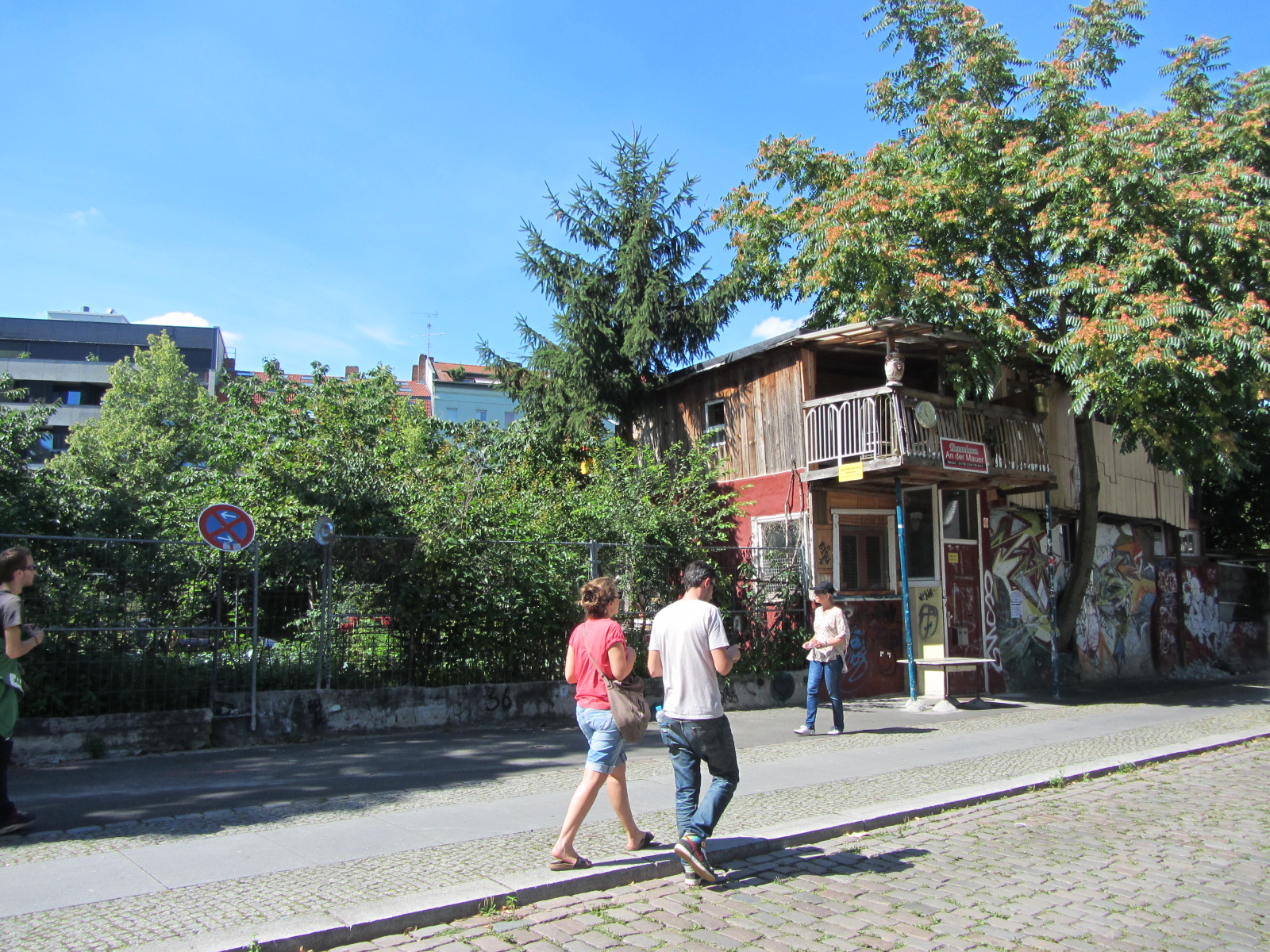
One of the next places was for me the most interesting of the tour, so I'm going to go into a bit more detail on it. The story begins with a Turkish immigrant named Osman Kalin who came to Berlin in the early 1980s. Because the Berlin Wall was built inside the East Germany border, there is space of few meters on the opposite side that was technically still East Germany land, and West Germans used this few meters to dump a lot of rubbish as a way of escaping disposal fees. Kalin saw opportunity in this, and in an empty lot started constructing a treehouse home and garden out of the discarded rubbish he found along the wall. The authorities from West Germany could do nothing, because the land was actually a little bend of East Germany that was left outside the wall to save on material costs, and the East Germans, once the ensured he wasn't trying to dig a tunnel to help people escape, decided to leave him alone. He continued to add to his house and garden, but when the wall came down in 1989 it was thrown into jeopardy. The new authorities wished to build a new road that would go through the lot, and since Osman was squatting there they tried to evict him. He responded by cementing all of his possessions to the ground. As pressure increased, the church next door stepped in. They dug out land ownership papers showing that before the war the lot was part of church land, and they said that they liked Mr. Kalin and his ethics and commitment to family, and wanted him to stay - a pretty noble stance for a Christian church to take towards an immigrant Muslim family. Osman Kalin still lives there, and an apartment next door runs a hose to give him fresh water in exchange for some of his fresh fruit and vegetables every month. It's a pretty unique place, and the sort of independent, off the grid lifestyle that fascinates me in Berlin.
Next it was over to Mitte, which I mentioned before. This time I got a lot more of the history on it though. Pre-war it was mostly full of Jewish families, and after the war there was an obvious void as many of the former inhabitants were either deceased or had no desire to return to Berlin. Eventually squatters took over, and it became the most squatted in region of the city, as well as a hub for independent art and music. As time passed, it became more trendy and people were evicted from their squats. There are still a few islands of that independent, artsy lifestyle hidden among the Starbucks and boutiques though. The place we went is one I have walked by at least twice, but never really noticed. You walk in through a tunnel to an inner courtyard plastered with street art. There is a bar and a small outdoor stage that puts on theatre and live music some nights, and inside a staircase saturated in stickers and graffiti that leads up to a shop that shows off local street art in a gallery and sells prints, art books, comics and other art-related items of independent artists. It was a very cool place, and something like what I had in mind for the sort of place I'd run if I ever decided to run a store (although something a bit easier to find wouldn't hurt).
Once the tour finished I even had a chance to finally go visit the sticker museum Hatch. It is also not easy to find, and you're only going to locate it if you know exactly what you're looking for and where to go. It's very small, consisting of just 3 rooms. One is dedicated to street art stickers, one to skateboarding and more commercial stickers, and a shop selling stickers and other merchandise. As expected, the street art part was the most interesting to me. The collection isn't too extensive, but it's interesting seeing the collected works of certain artists and both the evolution and reoccuring themes that come from them.
Our guide was a woman named Penny from England who is an alternative tour guide by day and an artist by night, and the first place she took us was by subway to the Schöneberg district. One place of interest there was a sprawling immigrant housing complex where an artist has painted most of the satellite dishes with whatever was selected as "the dream" of the family living within, and which is built around an abandoned old WW2 bunker simply because after 3 attempts they were unable to demolish it.
Also in the Schöneberg area we visited the gay district, with rainbow (and other) flags hanging from virtually every building.
You can't see the 3 flags great in that picture, but our guide helpfully informed us that the blue, white and black one is for sadomasochism and the brown and yellow one with the paw print is for "bear" culture. I guess places use them both as an invitation and a warning of what to expect there, depending on the clientele.
The next stage of the tour was mostly places I'd been already on my own during my earlier explorations, such as the Afro-Carribean beach club Yupp. Even having seen them before it was interesting to hear more of the history and of how a lot of these smaller underground places and squatter communities are being pressured by city development, and how in another 5 years the city could have a very different feel to it.
One of the next places was for me the most interesting of the tour, so I'm going to go into a bit more detail on it. The story begins with a Turkish immigrant named Osman Kalin who came to Berlin in the early 1980s. Because the Berlin Wall was built inside the East Germany border, there is space of few meters on the opposite side that was technically still East Germany land, and West Germans used this few meters to dump a lot of rubbish as a way of escaping disposal fees. Kalin saw opportunity in this, and in an empty lot started constructing a treehouse home and garden out of the discarded rubbish he found along the wall. The authorities from West Germany could do nothing, because the land was actually a little bend of East Germany that was left outside the wall to save on material costs, and the East Germans, once the ensured he wasn't trying to dig a tunnel to help people escape, decided to leave him alone. He continued to add to his house and garden, but when the wall came down in 1989 it was thrown into jeopardy. The new authorities wished to build a new road that would go through the lot, and since Osman was squatting there they tried to evict him. He responded by cementing all of his possessions to the ground. As pressure increased, the church next door stepped in. They dug out land ownership papers showing that before the war the lot was part of church land, and they said that they liked Mr. Kalin and his ethics and commitment to family, and wanted him to stay - a pretty noble stance for a Christian church to take towards an immigrant Muslim family. Osman Kalin still lives there, and an apartment next door runs a hose to give him fresh water in exchange for some of his fresh fruit and vegetables every month. It's a pretty unique place, and the sort of independent, off the grid lifestyle that fascinates me in Berlin.
Next it was over to Mitte, which I mentioned before. This time I got a lot more of the history on it though. Pre-war it was mostly full of Jewish families, and after the war there was an obvious void as many of the former inhabitants were either deceased or had no desire to return to Berlin. Eventually squatters took over, and it became the most squatted in region of the city, as well as a hub for independent art and music. As time passed, it became more trendy and people were evicted from their squats. There are still a few islands of that independent, artsy lifestyle hidden among the Starbucks and boutiques though. The place we went is one I have walked by at least twice, but never really noticed. You walk in through a tunnel to an inner courtyard plastered with street art. There is a bar and a small outdoor stage that puts on theatre and live music some nights, and inside a staircase saturated in stickers and graffiti that leads up to a shop that shows off local street art in a gallery and sells prints, art books, comics and other art-related items of independent artists. It was a very cool place, and something like what I had in mind for the sort of place I'd run if I ever decided to run a store (although something a bit easier to find wouldn't hurt).
Once the tour finished I even had a chance to finally go visit the sticker museum Hatch. It is also not easy to find, and you're only going to locate it if you know exactly what you're looking for and where to go. It's very small, consisting of just 3 rooms. One is dedicated to street art stickers, one to skateboarding and more commercial stickers, and a shop selling stickers and other merchandise. As expected, the street art part was the most interesting to me. The collection isn't too extensive, but it's interesting seeing the collected works of certain artists and both the evolution and reoccuring themes that come from them.
Labels:
Architecture,
Culture,
Germany,
Museums,
Politics,
Street Art,
Tour
Location:
Berlin, Germany
Thursday, July 12, 2012
Day 108: The Pest Side of the Danube
Since I spent most of yesterday on the west side of the city, today I stuck on the east side. I explored Vaci St again in more detail, specifically looking for clothes. I have discovered (not too surprisingly) that clothes wear out a lot faster when are constantly wearing, washing, packing, unpacking, wearing, etc them every couple of days, and I want to replace a few things while I'm somewhere that has good selection and is relatively inexpensive. I didn't buy anything in the end, but I'm going to go a few more places before I leave Budapest and will almost certainly pick up a few things.
For lunch I ate at Menza again. It had good, cheap food that is different every day, so as long as I'm in the area I may as well keep visiting. Today it was a cream of potato and cheese soup with a salmon and spinach pasta. I splurged and bought a lemonade with it as well, so it was $6 instead of $4!
Next I headed east on Andrassy Ave, which is the main street I've been using since it connects the place I'm staying with the city center. It's an old street with a lot of beautiful buildings, and the entire street is included in the Budapest UNESCO World Heritage site. I visited the House of Terror on the street, which had been recommended to me as the one museum to visit in Budapest if I was only going to visit one. The name sounds a bit like a haunted house, but the building (and the rest of the block) was used by both the fascist and communist regimes has a headquarters, and thousands of people were detained, interrogated, tortured and executed in a labyrinth of cells beneath the buildings. The building now is partly a museum of the regimes and partly a memorial to those who were killed. Even though they had good translations I found real history and information to be a bit lacking, but the audio-visuals of the place were pretty outstanding, if bizarre. A lot of rooms felt like walking through some eerie dream: walking through a maze where all the walls are made of wax bricks, a room where floorboards are ripped out and scorched with a giant glowing white cross lying in the dirt in the middle, a room that's dark except for tiny suspended white lights and a child's voice reading names (of the dead, I assume) - stuff like that.
I followed the street further east until I got to Heroes Square, Vajdahunyad Castle and the big park that surrounds them. It was another very hot day so I was happy to spend some time relaxing in the shade of the park and taking a break from walking.
The only real other thing of note I visited was the Central Market Hall. It's a big indoor market that was mainly food stalls on the ground floor and everything else on the upper walkways. I didn't buy anything, but it was a nice building and had a lot of fresh food.
For lunch I ate at Menza again. It had good, cheap food that is different every day, so as long as I'm in the area I may as well keep visiting. Today it was a cream of potato and cheese soup with a salmon and spinach pasta. I splurged and bought a lemonade with it as well, so it was $6 instead of $4!
Next I headed east on Andrassy Ave, which is the main street I've been using since it connects the place I'm staying with the city center. It's an old street with a lot of beautiful buildings, and the entire street is included in the Budapest UNESCO World Heritage site. I visited the House of Terror on the street, which had been recommended to me as the one museum to visit in Budapest if I was only going to visit one. The name sounds a bit like a haunted house, but the building (and the rest of the block) was used by both the fascist and communist regimes has a headquarters, and thousands of people were detained, interrogated, tortured and executed in a labyrinth of cells beneath the buildings. The building now is partly a museum of the regimes and partly a memorial to those who were killed. Even though they had good translations I found real history and information to be a bit lacking, but the audio-visuals of the place were pretty outstanding, if bizarre. A lot of rooms felt like walking through some eerie dream: walking through a maze where all the walls are made of wax bricks, a room where floorboards are ripped out and scorched with a giant glowing white cross lying in the dirt in the middle, a room that's dark except for tiny suspended white lights and a child's voice reading names (of the dead, I assume) - stuff like that.
I followed the street further east until I got to Heroes Square, Vajdahunyad Castle and the big park that surrounds them. It was another very hot day so I was happy to spend some time relaxing in the shade of the park and taking a break from walking.
The only real other thing of note I visited was the Central Market Hall. It's a big indoor market that was mainly food stalls on the ground floor and everything else on the upper walkways. I didn't buy anything, but it was a nice building and had a lot of fresh food.
Labels:
Architecture,
Food,
Hungary,
Politics,
Shopping
Location:
Budapest, Hungary
Thursday, June 28, 2012
Day 92: Ankara
This was the last real day of my tour, and it was spent on the way to and in Ankara, the capital of Turkey. Since the tour was down to just me my guide felt comfortable to deviate from the itinerary a bit and stop off at some random towns along the way to check out things he'd never had a chance to see and thought I'd be interested in. We stopped at a museum of discoveries from an ongoing Hittite excavation and in another small town named after the mystic Haji Bektash Veli (who, among other things, was said to be able to speak to animals) to visit his mausoleum/museum.
Once in Ankara we had two major places to visit. The first we went to was the Museum of Anatolian Civilizations. It's a pretty small museum, but the only real history museum I'd been to in Turkey, so it was a nice change from all the excavations.
The next stop was the tomb/museum for Mustafa Kemal Ataturk. I'm not sure how familiar people are with Ataturk. Before visiting, I certainly knew the name and that he was the founder of modern Turkey, but not much else. How he is treated in Turkey is the closest thing I've ever seen to the ancient greek hero-worship, and he really is a fascinating and incredibly important person, so I'm going to spend a bit of time talking about him and what he did.
Ataturk began in the military and gained popularity after his tactics and leadership led to great success in WW1 and the Turkish War of Independence. After the war he ultimately became the first president and almost single handed created a modern, progressive, secular state. A lot of people in the western world think of muslim countries as old-fashioned, unfair to women, and with governments dominated by religion, and I think it's important to highlight what was done in Turkey as a counter-example to that view. With the founding of the new republic, Ataturk explicitly declared a secular government. Women were give equal rights in all things to men, which in the 1920s/30s was revolutionary even in the western world. This included giving the right for women to vote, but also opening up all schools, all professions, all political office to women as well. He discarded the Muslim law of the Ottomans and created a new legal system of secular law. Education was also redone to combat high illiteracy and to bring a fragmented country together by promoting a common language and shared history. I highly recommend looking up Ataturk's Reforms, since I can only cover a fraction here, and it really is amazing how he transformed the country with his vision.
In every town I've been in Turkey, no matter how small, there is a monument in honour of Ataturk. As expected, his tomb/memorial/museum is an especially respected place.
Once in Ankara we had two major places to visit. The first we went to was the Museum of Anatolian Civilizations. It's a pretty small museum, but the only real history museum I'd been to in Turkey, so it was a nice change from all the excavations.
The next stop was the tomb/museum for Mustafa Kemal Ataturk. I'm not sure how familiar people are with Ataturk. Before visiting, I certainly knew the name and that he was the founder of modern Turkey, but not much else. How he is treated in Turkey is the closest thing I've ever seen to the ancient greek hero-worship, and he really is a fascinating and incredibly important person, so I'm going to spend a bit of time talking about him and what he did.
Ataturk began in the military and gained popularity after his tactics and leadership led to great success in WW1 and the Turkish War of Independence. After the war he ultimately became the first president and almost single handed created a modern, progressive, secular state. A lot of people in the western world think of muslim countries as old-fashioned, unfair to women, and with governments dominated by religion, and I think it's important to highlight what was done in Turkey as a counter-example to that view. With the founding of the new republic, Ataturk explicitly declared a secular government. Women were give equal rights in all things to men, which in the 1920s/30s was revolutionary even in the western world. This included giving the right for women to vote, but also opening up all schools, all professions, all political office to women as well. He discarded the Muslim law of the Ottomans and created a new legal system of secular law. Education was also redone to combat high illiteracy and to bring a fragmented country together by promoting a common language and shared history. I highly recommend looking up Ataturk's Reforms, since I can only cover a fraction here, and it really is amazing how he transformed the country with his vision.
In every town I've been in Turkey, no matter how small, there is a monument in honour of Ataturk. As expected, his tomb/memorial/museum is an especially respected place.
Location:
Ankara, Turkey
Subscribe to:
Posts (Atom)